The Fair-Start Pact: Choosing a Meeting Point Both Riders Can Live With
There is a particular kind of silence that settles over a buddy ride when one rider has been up since six, driven halfway across town and paid for parking, while the other has rolled out of bed and freewheeled ten minutes to the meeting point. Nothing has gone wrong, exactly. But the ride has started with a small imbalance, and everyone can feel it.
A fair start is not about measuring every kilometre with a ruler. It is about making the journey to the ride feel like part of the shared plan, rather than a favour one person has done for the other. In a UK town or city, that usually means choosing a meeting point with a bit of thought: somewhere safe, easy to find and genuinely convenient for both of you.
Start With the Journey, Not the Ride
When you are planning a buddy ride, the route tends to get all the attention. The start point gets treated like a pin on a map. But the start is the first thing you experience together, even if you arrive separately.
Before you agree on a place, have a quick, honest chat about how each of you will get there. Do you both live near a train station? Is one of you relying on a bus and a short ride? Does someone have a car, and would they be driving anyway? Are the evenings dark enough now that a poorly lit meet-up feels grim rather than friendly?
You do not need to turn this into a logistics meeting. A couple of messages is enough. The goal is simply to notice when the plan quietly asks one person to do all the travelling, all the parking and all the waiting.
The Midpoint Is a Place, Not Just a Pin
A true midpoint on a map can be a roundabout with no pavement, a lay-by with no lighting or a housing estate where you both feel slightly awkward standing next to your bikes. Fairness on paper is not much use if the meeting point is miserable in real life.
A good buddy-ride meeting point usually has a few simple things going for it. It should be easy to find, safe to stand around for ten minutes, and preferably have somewhere to grab a coffee or use a toilet. It also helps if it is not blocking a pavement, a taxi rank or a shop entrance. You want to begin the ride feeling welcome, not like you are loitering.
Think of the meeting point as a place with a reason to exist. A station forecourt, a café car park or a leisure centre entrance all do a job. A random street corner does not.
Stations: The Great Equaliser, With Caveats
Train stations are often the fairest meeting points for riders coming from different parts of town. They are usually well lit, covered, easy to find and connected to public transport. They also give the rider without a car a genuinely equal way to arrive.
There are caveats, though. Check the station layout before you commit. Some stations have lifts, some have stairs, and some have ticket barriers that make wheeling a bike through feel like a small obstacle course. If either of you is catching a train with a bike, look up the operator’s rules in advance. Space for cycles can be limited, especially at peak times.
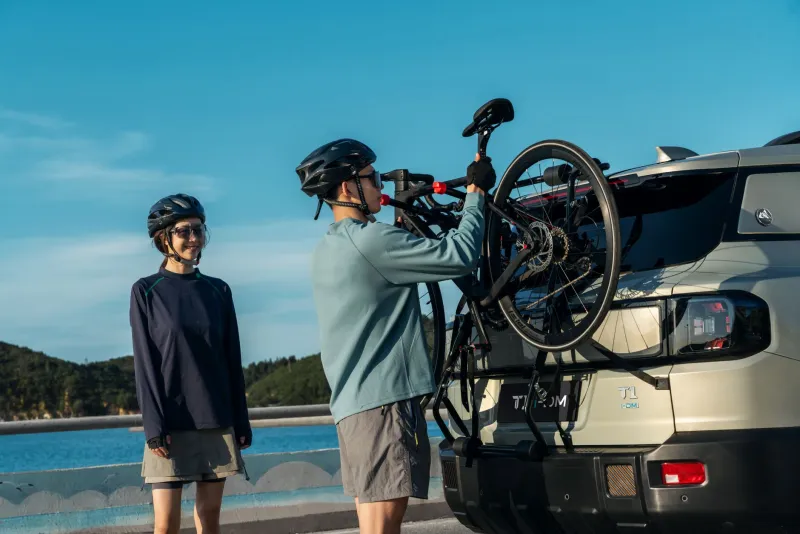
Also check whether the station car park charges and whether there is a sensible place to meet that is not the taxi rank. A quiet side entrance or the station café can be much nicer than the main drop-off point. If one rider is driving, they can often park near the station and join the other for the train-free section. That keeps the travel more balanced without making the plan complicated.
Café Car Parks and Leisure Centres
For riders who are both driving, a café car park or leisure centre is a strong choice. These places tend to have toilets, lighting and a clear sense of arrival. They are also usually easy to find, which matters when one of you is new to the area.
Do a little checking first. Some car parks are free for a couple of hours, some require a ticket, and some get very busy on weekend mornings. A retail park on a Saturday is not a relaxing start. A quiet garden centre café or a council-run leisure centre is often calmer.
And do the obvious good-manners bit: if you are using the café car park, buy something. It keeps the relationship friendly and it means you are a customer rather than a mystery. Meet away from the entrance so you are not in anyone’s way, and agree a precise spot. “By the bike racks” is better than “somewhere near the café”.
Loop Routes and the Rotating Start
If the ride is a loop, you have more freedom. You can choose a start point that sits roughly between the two of you, then finish back there. That is often the simplest fair-start solution: neither person gets the shortest journey every time, and the ride itself does the work of bringing you together.
Another option is to rotate. One month, the ride starts near one rider’s side of town. Next month, it starts near the other’s. The third time, you pick a midpoint. Over a season, the faff evens out. This works particularly well for regular buddies who want to keep things social without pretending that travel time does not exist.
If one of you has a car and the other does not, rotating can still work. The driver can sometimes park near a station or a sensible midway point, and the non-driver can use public transport. It is not about making every ride identical. It is about making sure the same person is not always the one doing the extra hour.
A Fair Start Has a Plan B
A meeting point is only as good as its backup. In the UK, a train can be cancelled, a car park can be full and the weather can turn a cheerful plan into a soggy one. Before you set off, agree what happens if things go wrong.
Share the exact pin, not just the name of the area. Agree a backup meeting point nearby. If one of you is coming by train, have a quick look at the next service. If one of you is driving, check whether there is alternative parking within a few minutes’ ride. This is not doom-mongering. It is just the sort of small preparation that keeps a beginner-friendly ride feeling calm.
The First Ten Minutes Matter
Once you are both there, do not launch straight into the ride. Give yourselves a few minutes to say hello properly, check bikes, adjust a helmet and finish a coffee. A good meeting point should let you stand around without feeling in the way.
Arrive five minutes early rather than twenty. That way you are not hanging about in the cold, but you are also not the rider who turns up flustered and apologetic. The first ten minutes set the tone. A fair start gives you both a chance to arrive, breathe and remember why you arranged the ride in the first place.
The Fair-Start Checklist
Before you lock in the meeting point, run through this quick list:
- Is the travel time roughly balanced, or at least clearly agreed?
- Is the spot safe, lit and easy to find?
- Is there somewhere to park legally, use a toilet or buy a coffee?
- Can both riders reach it without relying on one person’s car?
- Have you shared an exact pin and a landmark?
- Have you agreed a backup plan and a finish point?
A fair start is not about perfection. It is about making the effort visible. When both riders feel that the plan has considered them, the ride begins in the right spirit: two people meeting as equals, ready for a good natter and a few miles together.