Same Route, Different Motors: Planning a Ride Where E-Bikes and Legs Share the Road
Photo: Alberto Ballón Landa, Public domain, via Wikimedia Commons
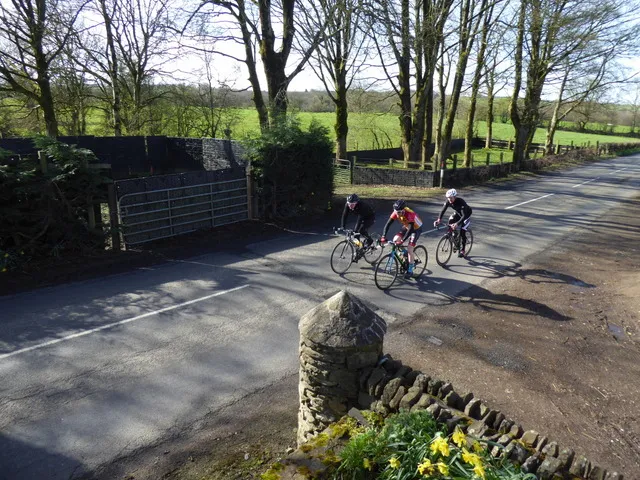
Somewhere on a Chilterns lane this weekend, someone on a motor-assisted hybrid is going to pull alongside a mate on a battered winter bike and say something they'll regret. Not out of malice. It's just that mixed-energy rides are the one corner of group cycling nobody briefs you on. One of you is doing 250 watts; the other is doing 250 watts plus a small, silent helper. The route has to suit both of you, and so does the conversation.
The good news: a mixed bunch is often the friendliest bunch on the road. It gets people out who'd otherwise be put off by a hill, and it gives faster riders a reason to slow down and actually talk. It just needs a bit of thought before anyone clips in.
Start with the battery conversation, before the day
This is the bit people skip because it feels nosy. It isn't. Ask directly: what assist level do you normally ride in, what range does the display claim, and how far have you actually gone on a charge?
In the UK, a legal pedelec gives you assistance up to 25 km/h (about 15.5 mph) and cuts out above that, so a fit rider on a light road bike will still be quicker on the flat and downhill. Where the e-bike wins is the climbs and the headwind home. That asymmetry is the whole planning problem in a sentence.
Take the claimed range and treat it as marketing. Cold weather, a heavy hybrid, a rider carrying shopping and a route with three proper climbs will all eat into it. A sensible rule of thumb: plan a route at roughly two-thirds of the range the rider says they get in summer. A 60-mile claimed range becomes a 40-mile day out, with margin for a wrong turn and a slow café queue.
Also ask about the charger. If your stop is a village hall or a National Cycle Network tea room with a willing socket, twenty minutes of top-up is worth a lot of reassurance. Don't count on it, though — plenty of cafés will say yes and then quietly unplug you when the urn goes on.
Pacing a mixed group without a tow rope
The core principle is simple: the group rides at the pace of the least assisted rider uphill, and at the pace of the least powerful rider on the flat. Everyone can hold that.
On the climbs, the e-bike rider should sit with the bunch rather than surging ahead and waiting at the top looking refreshed. That waiting-at-the-summit pose is the single most effective way to make someone feel rubbish about their legs. Ride alongside, chat, and if the gradient is genuinely too steep for a conversation, agree to regroup at the top and mean it.
On the flat, the assisted rider can help by knocking the motor down a level or two. The point of the day is company, not efficiency. A mixed ride where the e-bike is permanently in Turbo and the other rider is gasping is not a buddy ride — it's a pursuit.
Agree the regroup points in advance. A bridge, a junction, the top of the long drag, the pub with the hanging baskets. Three or four named points on a 40-mile route is plenty, and it removes the anxiety of wondering whether the person behind took a wrong turn at the roundabout.
Who carries what
Short answer: everyone carries their own. Long answer below.
Every rider should have a tube in the right size, levers, and a pump that actually fits their valve. E-bikes are a common trap here — smaller wheels, chunky tyres, and sometimes a Presta valve on one wheel and something else on the other. Check before you leave rather than at the roadside in the rain.
Don't treat the e-bike rider as the group sherpa simply because they have panniers. Yes, they've got space; no, that doesn't make them the support vehicle. A spare tube, a multi-tool with the right bits (some e-bikes use Torx bolts), a phone, a tenner and a bank card is the standard kit for all.
E-bike riders should add one thing: the battery key, if it's removable. Losing it mid-ride means a very heavy, very unassisted ride home. A small cable lock is worth the weight too, for the café stop.
The small etiquette points that keep it sociable
- No surging. If you're on assist, don't blast past on the climb and then coast. It reads as showing off even when it isn't meant that way.
- No smug comments on the flat. "Cheating" was funny in about 2016. Same for "I'd be fast too if I had a motor" — say it once, to a friend, if you must, and then let it go.
- No pity. Don't ask the assisted rider if they're "managing okay" on the flat. They're fine. They just chose a different bike.
- Warn before you change pace. A sudden surge from either side of the divide breaks the group faster than a hill ever will.
- Descend together. Legal e-bikes cut assistance at 25 km/h, so assisted riders often lose ground going downhill. Wait at the bottom.
The ride that works
The best mixed ride we've heard about recently finished with the e-bike rider and the roadie both saying they'd do it again — and swapping bikes for the last five miles. That's the trick, really. A motor doesn't change what makes a good buddy ride: matching expectations, agreeing the plan, and choosing company over pace. Sort the battery chat, name your regroup points, and the rest looks after itself.