One Way, No Faff: Train-Hopping Buddy Rides That Finish Somewhere New
Photo: Alfredo Borba, CC BY-SA 4.0, via Wikimedia Commons
Most cycling routes are loops. You park, ride, return to the same spot, and drive home. Lovely — but not always practical for a mixed-ability group, and not much help if nobody in the buddy group owns a car. The train opens up a different shape of day: start at one station, finish at another, and let the railway do the boring bit.
Train-assisted rides are not just for experienced riders doing audax epics. They are arguably better for beginners and social groups. You can pick a gentle linear route, meet at a station, ride at chatting pace, and end somewhere with a pub, a cafe or a direct train home. The trick is planning around the railway rather than treating it as an afterthought.
Start with the timetable, not the map
It is tempting to find a beautiful route first and worry about trains later. Resist that. In 2026, bike spaces on UK trains are still a postcode lottery: some operators require reservations, some are first-come-first-served, and some have very few spaces per train. Check the journey before you fall in love with the route.
Pick two stations on the same line, or on lines that connect easily. Look for a service that runs at least hourly in both directions, because a missed train should not end the day. Avoid tight connections with bikes — a five-minute change is fine on foot and a small nightmare with four riders and panniers.
Also check for engineering works. Replacement buses are the enemy of the train-assisted bike ride, and they often appear at weekends, which is exactly when buddy groups tend to travel. A quick look at National Rail or the operator's own site will save a lot of standing around on a wet platform.
Pick a route with escape hatches
The best beginner-friendly linear route has stations along the way, not just at each end. Think of them as bail-out points: if the weather turns, someone's knee starts complaining, or the group is simply having a slower day than expected, you can hop on a train and shorten the ride without derailing the whole outing.
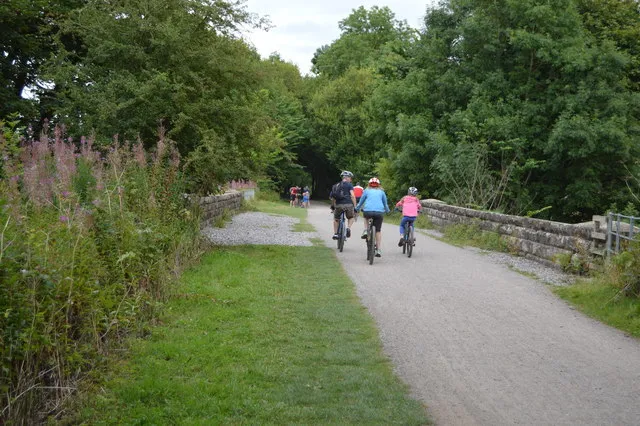
Canal towpaths, disused railway paths and quiet country lanes are good candidates. A route from, say, a market town to a cathedral city might be twenty gentle miles with two intermediate stations. That is far more sociable than a twenty-mile loop with no plan B. The group can split if needed, and nobody has to feel like they are holding everyone up.
Check the surface, too. A gravel towpath in July is lovely; the same path in February can be a muddy slog. Beginner groups should err towards smooth tarmac or well-made paths, especially if anyone is riding a hybrid with skinny-ish tyres or a bike they have not owned for long.
Booking bike spaces without the panic
Bike reservations vary by operator. Some train companies let you book a free bike space when you buy a ticket; others require a separate reservation; some regional services do not take reservations at all and simply ask you to turn up and be sensible. Read the operator's bike policy for the exact route you are using, not just the first train company that comes to mind.
Book early for weekend trains, especially in spring and summer. A group of four bikes is harder to fit than one. If the direct train is full, look at splitting the journey or using a slower service — the quiet, stoppy local train is often more bike-friendly than the fast intercity, and it is usually more relaxed for a buddy group anyway.
On the day, arrive with time to spare. Take panniers off if you need to lift the bike, and have a rough plan for who is lifting what. A cheerful, organised group gets on the train much more easily than a chaotic one. And if the guard says the bike space is full, stay polite — the timetable is not personal, even when it feels like it.
Pack for a one-way day, not an expedition
One-way rides tempt you to overpack. You do not need three layers, a full tool chest and a spare tyre for a twenty-mile pootle. You do need a light waterproof, a basic repair kit, a pump, a spare tube, a lock and enough food and water for the ride. A small rucksack or saddlebag is usually plenty.
Bring a charged phone and a battery pack, especially if you are navigating. Screens drain fast when you are taking photos, checking train times and messaging the group chat. A paper note of the train times is old-school and genuinely useful when signal disappears.
Dress for the train as well as the ride. A sweaty cyclist in a packed carriage is nobody's favourite travel companion. Layers you can peel off at the station, plus a lightweight jacket, make the whole day more comfortable.
Build in the biscuit stops
A train-assisted ride should not feel like a race to catch a train. Plan at least one proper stop, ideally around halfway, and check that the cafe is actually open. Rural cafes often have odd winter hours, and a group arriving at a closed tearoom is a sad sight.
Look for places with bike parking, outdoor seating and a menu that suits a range of appetites. A village hall cafe, a canal-side tearoom or a National Trust spot can be perfect. The stop is not a delay; it is part of the ride. It gives everyone a chance to chat, check in and decide whether to stick to the plan or take the easier option.
The little checks that save the group
Before you go, share the route, train times and bail-out stations in the group chat. Agree a meeting point at the start station — platform, ticket hall, bike racks — and a rough plan for what happens if someone misses the train. Nominate a back marker if the group is bigger than four. Check everyone has a ticket and a bike reservation if needed.
Finally, be honest about the route. A linear ride can be gently downhill, gently uphill or secretly hilly. Look at the elevation profile and tell the group what to expect. Beginner-friendly does not mean flat, but it does mean no nasty surprises.
Train-assisted buddy rides are not complicated. They just ask you to plan in a slightly different order: railway first, route second, biscuits third. Do that, and you get a day that feels like an adventure without the car park loop at the end.